
Looking for professional biodigester construction in Kenya? Beulah Works Ltd provides biodigester design, construction and installation for homes, apartments, commercial properties, institutions and other developments requiring an efficient on-site wastewater management system.
We handle the complete process from site assessment and excavation to biodigester construction, drainage connections, soakaway installation, testing and commissioning.
A properly designed biodigester provides a practical wastewater solution where connection to a conventional sewer network is unavailable or unsuitable.
REQUEST A BIODIGESTER QUOTE
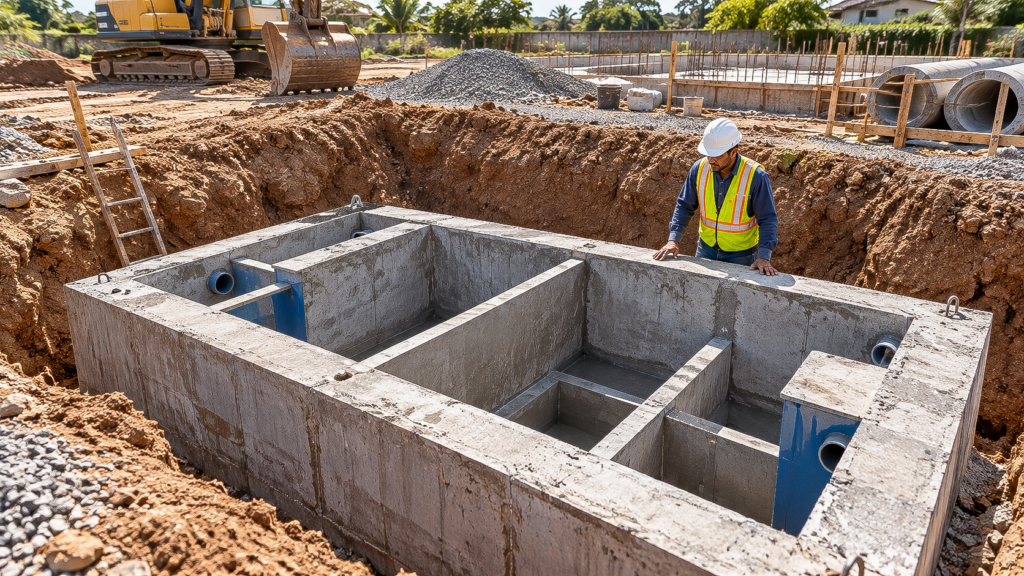
A biodigester is an on-site wastewater treatment system designed to receive sewage and use biological processes to break down organic waste.
Wastewater from toilets enters the biodigester, where solids are broken down under controlled biological conditions. The resulting effluent then leaves the treatment chamber and is directed to an appropriately designed soakaway or other approved disposal system.
Unlike simply digging a pit to hold wastewater, a biodigester must be properly sized, positioned, constructed, ventilated, connected and provided with suitable effluent disposal.
At Beulah Works Ltd, we consider the entire wastewater system rather than treating the biodigester tank as an isolated structure.
Our biodigester works can include:
The exact scope depends on the property type, number of users, site conditions, wastewater volume and selected biodigester system.
Biodigesters can be designed for a wide range of developments.
A biodigester can provide an on-site wastewater solution for a bungalow, maisonette or other private residence where there is no suitable sewer connection.
Apartment developments normally require larger wastewater systems because the number of users and daily sewage flow are considerably higher than in an individual home.
Correct sizing is particularly important for rental developments where occupancy may increase in the future.
Biodigesters can be incorporated into offices, shops, accommodation facilities and other commercial developments, subject to proper assessment of wastewater volumes.
Schools and other institutions may generate substantial wastewater within relatively short periods. The system therefore needs to be designed according to expected user numbers and operating conditions.
A biodigester can also be incorporated into a larger development together with house construction, drainage, cabro paving, perimeter walls and other civil works.
A biodigester wastewater system generally works through a sequence of collection, biological treatment and effluent disposal.
Sewage from toilets is carried through the drainage pipework into the biodigester chamber.
Naturally occurring microorganisms and biological processes help break down organic matter inside the system.
Retention within the system allows the wastewater to undergo treatment before liquid effluent moves towards the outlet.
The liquid effluent is discharged through the outlet system.
Depending on the site design and ground conditions, effluent may be directed to an appropriately designed soakage system.
Every property is different, so construction should start with understanding the site rather than selecting a tank size without assessment.
We assess factors such as:
These factors influence the design, position and capacity of the wastewater system.
The biodigester should be sized according to the expected wastewater load rather than simply the number of bedrooms in the building.
For example, a house occupied by three people does not generate the same wastewater volume as an apartment development occupied by dozens of residents.
Future occupancy should also be considered where practical.
The position of the biodigester, inspection chambers, drainage lines and soakage area is established before excavation begins.
Correct levels are important because the drainage system generally relies on gravity to move wastewater from the building towards the treatment system.
Excavation is carried out according to the dimensions and levels required by the system design.
Ground conditions can significantly influence the excavation method and construction requirements.
Depending on the project, the system may involve a properly designed site-built structure or an appropriate prefabricated treatment unit.
Connections, access points and other components are installed according to the system requirements.
Installing the treatment chamber alone is not enough.
The project may also require:
Proper effluent disposal is one of the most important parts of the complete biodigester installation.
The completed system is inspected and tested before full use.
There is no single biodigester size suitable for every property.
The required capacity depends on several factors including:
A biodigester for a single residential house can therefore be very different from one serving apartments, a school, commercial premises or an accommodation facility.
Correct sizing helps prevent overloading and improves the long-term performance of the wastewater system.
Biodigester location should be considered during site planning rather than after the house and external works have already been completed.
Important considerations include:
This is why the biodigester should ideally be considered at the planning stage of a new construction project.
The soakaway is a critical part of many biodigester installations.
Its purpose is to receive effluent leaving the treatment system and allow appropriate dispersal according to the design and site conditions.
A soakaway that is too small or constructed in unsuitable ground may result in:
Soil conditions therefore matter.
Good-draining soils behave differently from heavy clay soils or sites with a high groundwater table. The effluent disposal solution should be selected based on the actual site.
The cost of biodigester construction in Kenya varies because wastewater systems should be designed for the requirements of the specific property.
Major cost factors include:
For this reason, Beulah Works Ltd recommends obtaining a project-specific quotation rather than selecting a wastewater system purely on an advertised starting price.
GET A BIODIGESTER CONSTRUCTION QUOTE
Both systems manage wastewater, but they operate differently.
| Biodigester | Septic Tank |
|---|---|
| Uses biological treatment processes | Primarily separates and retains solids |
| Can require a smaller overall treatment footprint depending on design | Often requires a larger tank and associated disposal area |
| Sludge accumulation may be reduced | Sludge accumulates and requires periodic removal |
| Requires correct biological operating conditions | Uses relatively simple settlement processes |
| Needs appropriately designed effluent disposal | Also requires appropriately designed effluent disposal |
| Maintenance depends on system design and usage | Periodic inspection and desludging are required |
The correct choice depends on your property, occupancy, site conditions, available space, construction budget and wastewater requirements.
A properly selected biodigester can be useful on developments where available space needs to be carefully managed.
The system uses biological processes to break down organic waste before effluent disposal.
Systems can be designed for individual houses, apartments, institutions and commercial properties.
Effective biological treatment can reduce the amount of accumulated solids compared with simple storage or settlement systems, although maintenance requirements still depend on design and use.
The drainage system, biodigester and soakaway can be incorporated into the overall construction works from the beginning of the project.
Many wastewater problems originate from poor planning rather than the biodigester itself.
Common mistakes include:
Professional assessment before construction helps reduce these risks.
A biodigester should not be treated as a structure that can simply be buried and forgotten.
Good operating practices may include:
Maintenance requirements depend on the particular system installed and how heavily it is used.
We consider the complete system including excavation, treatment chambers, drainage, inspection points and effluent disposal.
Because Beulah Works Ltd handles both building and civil works, biodigester construction can be coordinated with the wider development.
We consider the actual property conditions instead of assuming that one biodigester design is suitable for every site.
Ground levels, drainage routes, construction access and future property development are considered before works begin.
Your biodigester project can be coordinated with our other construction services, including:
If you are planning a new home, the best time to plan the biodigester is before external works are completed.
Early planning makes it easier to coordinate:
Beulah Works Ltd can incorporate these works into the overall house construction project, reducing conflicts between wastewater infrastructure and later external works.
Planning a new biodigester for your home, apartments, commercial property or development project?
Beulah Works Ltd can assess your project requirements and provide a quotation based on the proposed system and site conditions.
For a more accurate quotation, provide: